
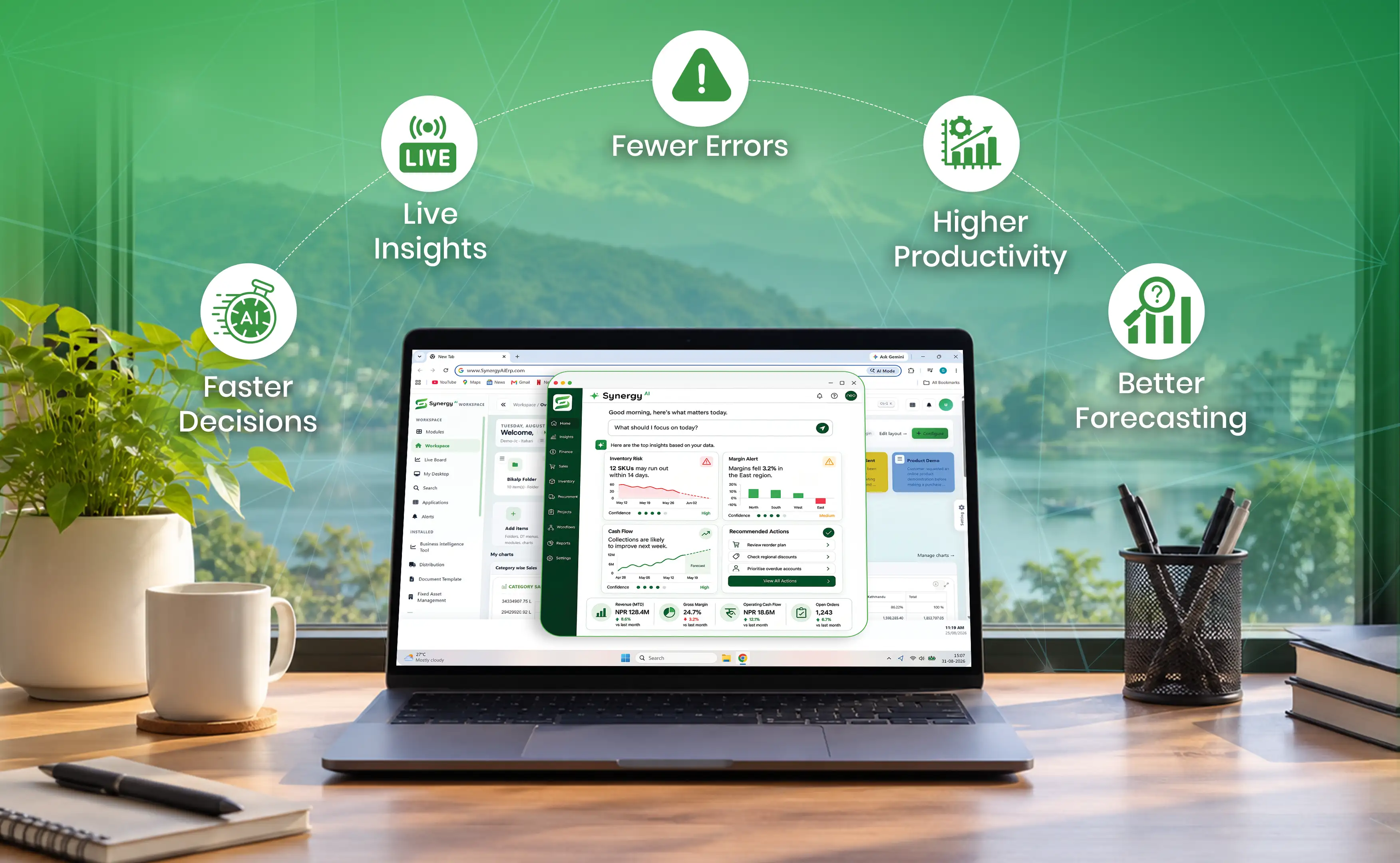
Traditional ERP systems record business data. AI-powered ERP goes further: it helps businesses understand that data, predict what may happen next, and take faster, smarter action. By combining machine learning, predictive analytics, natural language processing, and generative AI, AI in ERP turns everyday business information into practical decisions.
It connects finance, inventory, sales, HR, procurement, and operations in one intelligent system, so teams can work from the same real-time source of truth.
What Is AI in ERP?
AI in ERP is the use of artificial intelligence inside ERP software to automate work, analyze patterns, and support decision-making. Instead of only storing transactions, an intelligent ERP can identify trends, answer questions, flag risks, and recommend next steps.
Core AI technologies in ERP include machine learning, predictive analytics, natural language processing, generative AI, and automation.
Machine learning learns from historical and live business data to identify patterns. Predictive analytics uses these patterns to forecast demand, cash flow, stock needs, and risks. Natural language processing lets users interact with ERP data in everyday language, while generative AI creates summaries, explanations, and reports from business data.
Automation and workflow intelligence reduce repetitive tasks and route exceptions to the right people, helping teams work faster and make smarter decisions.
The key difference is simple: traditional ERP tells you what happened, while AI ERP software helps you understand why it happened and what to do next. AI enhances ERP; it does not replace it.
|
Aspect |
Traditional ERP |
AI-Powered ERP |
|
Primary role |
Records transactions |
Understands, predicts, and recommends actions |
|
Reporting |
Manual and historical |
Real-time, automated, and predictive |
|
Automation |
Fixed rules |
Intelligent workflows and AI assistance |
|
Decision-making |
Reactive |
Proactive and data-driven |
|
User experience |
Menus and reports |
Dashboards, alerts, and conversational queries |
Why Businesses Need AI-Powered ERP
Many businesses still manage operations through disconnected spreadsheets, delayed reports, and manual data entry. This creates inventory errors, slow approvals, missed risks, and decisions based on outdated information. AI-powered ERP addresses these problems by connecting data and applying intelligence across departments.
The main benefits include:
-
Faster and smarter decision-making: Leaders can act on live insights instead of waiting for month-end reports.
-
Real-time visibility: Finance, sales, HR, and operations see the same updated business picture.
-
Reduced manual errors: AI can help detect duplicates, mismatches, and unusual transactions.
-
Improved productivity: Teams spend less time on repetitive admin work and more time on high-value tasks.
-
Better forecasting: Predictive analytics supports demand planning, inventory control, and cash-flow management.
-
Stronger collaboration: Departments work from one connected platform instead of separate systems.
How AI Is Transforming Key ERP Functions
AI is improving every major ERP function by turning business data into faster decisions, automated workflows, and predictive insights. From finance and inventory to procurement, HR, and manufacturing, AI-powered ERP helps teams reduce manual work, prevent errors, and respond to business needs in real time.
To get the best results, businesses should adopt AI in ERP with clean data, clear processes, and human oversight. Start by centralizing accurate customer, vendor, inventory, sales, and financial data. Then focus on high-impact areas such as inventory planning, procurement, reporting, and receivables.
AI can recommend actions and automate routine work, but managers should approve high-risk or compliance-related decisions. Training employees to use dashboards, alerts, workflows, and AI assistants is equally important. Finally, measure results through time saved, reporting speed, stock accuracy, error reduction, and improved decision-making.
How to Adopt AI in ERP Successfully
AI delivers results only when it is implemented with clean data, clear processes, and human oversight. Businesses should take a practical, phased approach:
-
Clean and centralize business data. AI insights depend on accurate customer, vendor, inventory, sales, and financial data.
-
Start with high-impact processes. Inventory planning, procurement, reporting, and receivables are strong starting points.
-
Keep human approval for critical decisions. AI can recommend actions, but managers should validate high-risk or compliance-related decisions.
-
Train employees. Teams should know how to use dashboards, alerts, workflows, and AI assistants in daily work.
-
Measure results. Track time saved, reporting speed, stock accuracy, error reduction, and decision-making improvements.
Why Growing Businesses in Nepal Need ERP
As businesses in Nepal grow, managing finance, inventory, procurement, HR, and operations through separate tools becomes increasingly difficult. An AI-powered ERP brings these functions together, improves visibility, and supports faster decisions across locations and departments.
It provides:
-
One connected platform for finance, inventory, sales, HR, procurement, and operations.
-
Real-time dashboards that reflect live business activity.
-
Intelligent workflows that reduce repetitive manual work.
-
AI-driven recommendations across business processes.
-
Cross-department transparency, with every transaction visible across teams and locations.
-
A built-in generative AI assistant that helps users access insights without advanced reporting skills.
Final Thoughts
AI is transforming ERP from a system that records business activity into an intelligent platform that predicts risks, automates work, and supports better decisions. From finance and inventory to procurement, HR, and manufacturing, AI-powered ERP helps businesses become more visible, efficient, and responsive.
For growing businesses, Synergy AI offers a practical way to bring AI, automation, and real-time business intelligence into one connected ERP platform.
Explore Synergy AI and book a personalized 30-minute demo.
FAQs
What is AI in ERP?
AI in ERP is the use of artificial intelligence technologies such as machine learning, predictive analytics, natural language processing, and generative AI inside ERP software to automate tasks, analyze data, and support better decisions.
How does AI improve ERP systems?
AI improves ERP systems by providing real-time insights, predictive forecasts, intelligent automation, anomaly detection, and conversational access to business data. This helps teams make faster and more informed decisions.
Is AI ERP suitable for small and mid-sized businesses?
Yes. AI ERP can benefit small and mid-sized businesses by reducing manual work, improving inventory accuracy, strengthening financial visibility, and supporting growth without adding excessive administrative burden.
What is the difference between ERP automation and AI in ERP?
ERP automation follows predefined rules, such as routing an approval or generating a recurring report. AI in ERP goes further by learning from data, identifying patterns, predicting outcomes, and recommending or supporting decisions.
How can Nepali businesses benefit from AI-powered ERP?
Nepali businesses can use AI-powered ERP to connect departments, improve inventory and procurement control, speed up reporting, strengthen financial visibility, and make growth decisions based on real-time data.